

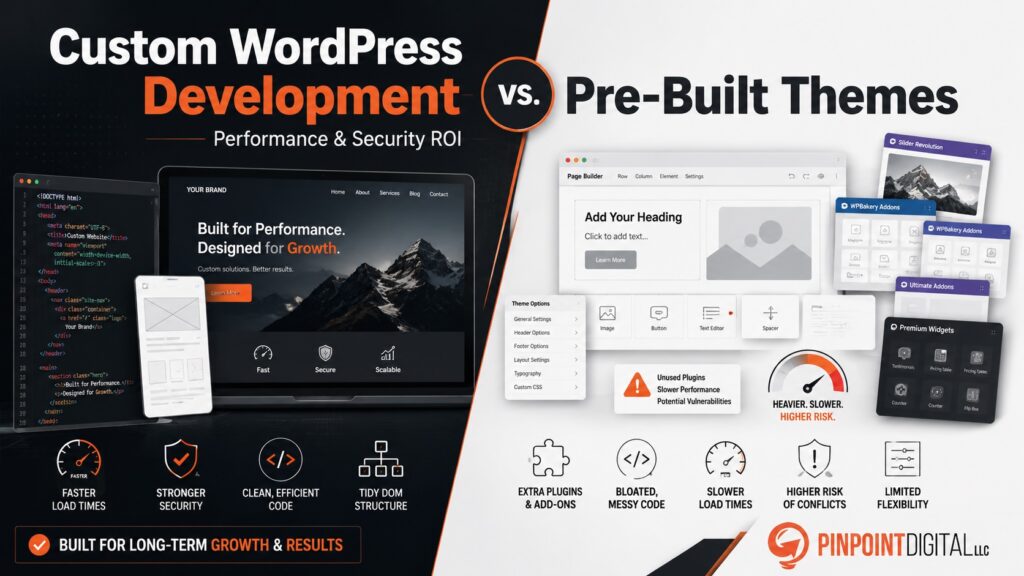
For a growing business, custom WordPress theme development can provide stronger long-term performance, cleaner code, easier scalability, and tighter control over security than a heavily customized off-the-shelf theme. Pre-built Elementor, Divi, and other page-builder setups can launch quickly, but they may also include layouts, scripts, widgets, CSS, and third-party add-ons that a site never uses. At Pinpoint Digital, LLC, we prefer matching the development approach to the business rather than forcing every company into the same template. A well-built custom PHP or Gutenberg WordPress theme can reduce unnecessary front-end complexity while giving developers greater control over performance, SEO, updates, and future expansion. WordPress itself stresses secure coding practices, keeping code current, and carefully validating, sanitizing, and escaping data.
Custom Website vs. WordPress Theme: What Is the Real Difference?
When businesses compare a custom website vs WordPress theme, the biggest difference is not WordPress itself.
Both can run on WordPress.
The difference is how much code and functionality are being loaded to produce the final website.
A general-purpose commercial theme may need to support hundreds of layout combinations, sliders, animations, headers, widgets, WooCommerce options, design controls, and integrations.
That flexibility can be useful for a DIY website. It also means a business may be carrying features that serve no purpose on its actual pages.
With custom development, we can build around what the business actually needs.
That can include:
- Custom Gutenberg blocks
- Purpose-built PHP templates
- Lean CSS and JavaScript
- Reusable service-page layouts
- Structured data
- Conversion-focused forms
- Custom post types
- Local SEO architecture
- Only the functionality required for the project
Our Connecticut web design services focus on custom solutions, responsive layouts, clean code, fast load times, SEO, and scalability rather than a one-size-fits-all template approach.
Why Pre-Built Themes Can Become Slow
Elementor, Divi, and similar page builders are not automatically slow. Strong hosting, caching, image optimization, and careful configuration can produce good results.
Problems tend to appear when a site accumulates layers of functionality.
A typical template-based build may include:
Theme framework + page builder + widget packs + animation library + form plugin + slider + optimization plugin + custom CSS + tracking scripts
Each component can add HTTP requests, JavaScript execution, CSS, database queries, or DOM elements.
Over time, the development team may spend more effort suppressing unnecessary functionality than building useful functionality.
A purpose-built theme gives us the opportunity to start with less.
Clean DOM Trees Matter for Performance
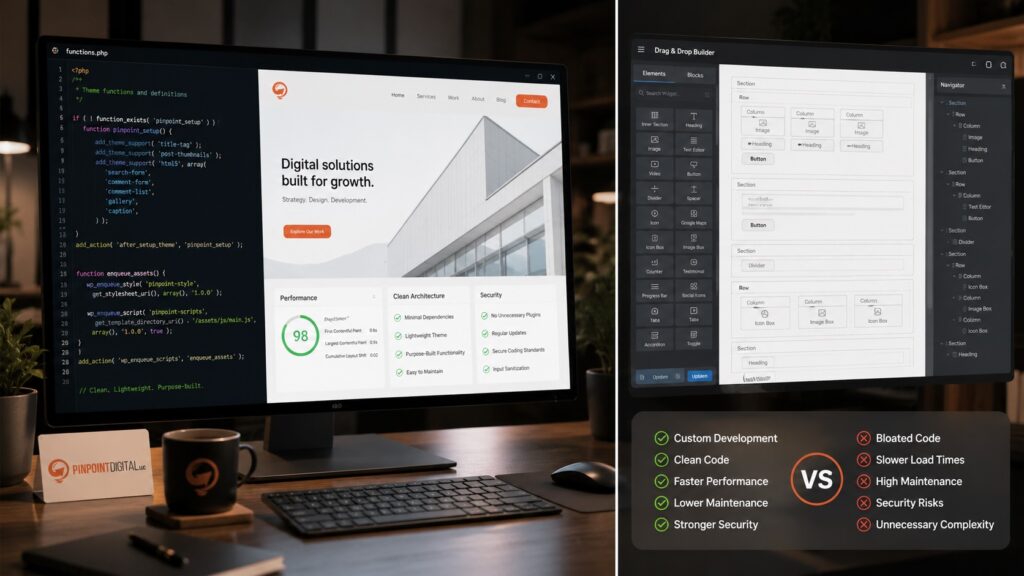
Page builders often rely on nested containers or wrappers to provide flexible visual controls.
More markup does not automatically make a page slow, but excessively complex DOM structures can increase the amount of work a browser performs when calculating layouts, applying styles, and rendering pages.
A custom Gutenberg theme can use simpler HTML structures designed around actual content.
Instead of:
container → wrapper → inner wrapper → row → column → widget → content
a custom block may need only the semantic elements required to display that section.
Cleaner structure can also make future development and troubleshooting easier.
Custom WordPress Theme Benefits for Security
Security is another reason we evaluate how much functionality a website truly needs.
Every theme, plugin, extension, and custom integration requires maintenance.
Reducing unnecessary components can reduce the number of systems that must be monitored and updated. That does not mean custom code is automatically secure. Poorly written custom code can create vulnerabilities too.
The advantage is control.
With custom development, developers can follow established WordPress security practices for validation, sanitization, escaping, permissions, and ongoing maintenance rather than depending on many unrelated third-party extensions.
The official WordPress Security documentation specifically recommends treating all incoming data as untrusted, using WordPress APIs when possible, and keeping code current.
The Hidden Cost of Plugin Dependency
A $50 theme can look inexpensive on launch day.
The real cost appears later.
Suppose a business needs a custom directory, advanced service-area pages, quote calculator, CRM connection, unusual content structure, and conversion tracking.
A template may require several plugins and workarounds to make those features fit.
Then one plugin changes.
Another conflicts with a WordPress update.
A page-builder extension stops receiving support.
A developer adds another plugin to solve the first plugin’s problem.
That creates technical debt.
Our related guide on the hidden cost of cheap web design covers how inexpensive builds can eventually create higher maintenance costs, performance problems, and scalability limitations.
Comparing Long-Term ROI
The best option depends on what the website needs to accomplish.
| Factor | Pre-Built Theme | Custom WordPress Theme |
|---|---|---|
| Initial development | Usually lower | Usually higher |
| Launch speed | Usually faster | Longer development cycle |
| Design flexibility | Theme-dependent | Built around the brand |
| Unused functionality | Can be substantial | Can be minimized |
| Plugin dependency | Often higher | Can be reduced |
| Performance control | Varies | High |
| Custom functionality | May require add-ons | Can be purpose-built |
| Long-term scalability | Theme-dependent | Designed around growth |
| Maintenance | Multiple vendors may be involved | More centralized control |
For a small informational site with a limited budget, a reputable pre-built theme may be perfectly reasonable.
For a business investing heavily in SEO, paid traffic, lead generation, e-commerce, or custom functionality, the economics can change.
A faster, cleaner, easier-to-maintain platform may produce better value over several years even when development costs more upfront.
When We Recommend Custom WordPress Development
We typically see the strongest case for custom development when a business needs:
- Strong Core Web Vitals performance
- Large-scale SEO expansion
- Custom landing pages
- Complex service-area architecture
- Custom integrations
- Specialized lead-generation features
- Long-term scalability
- Greater development control
- Reduced reliance on third-party add-ons
The goal is not customization simply for the sake of being custom.
The goal is building only what creates business value.
Build WordPress Around the Business, Not the Theme
The biggest custom WordPress theme benefit is control.
Rather than asking how a company can fit inside a purchased theme, we can start with the company’s goals, customers, content, SEO strategy, and conversion process, then build the website around those requirements.
At Pinpoint Digital, LLC, we develop WordPress websites with performance, security, search visibility, conversions, and long-term maintainability in mind.
A website should not become harder to manage every year it exists. A strong development foundation should make growth easier.