

Search has changed. Homeowners no longer rely only on a blue link list when looking for a roofer, plumber, landscaper, paving company, electrician, or home service contractor. Google rich results, map packs, AI Overviews, voice search, and large language models now pull answers from trusted, machine-readable sources.
At Pinpoint Digital, we build digital marketing strategies for Connecticut businesses that need more than basic SEO. Our work covers web design, development, search engine optimization, paid ads, and full digital marketing for local service brands across Plainville, Hartford, New Britain, Burlington, West Hartford, Bristol, Southington, New Haven, and surrounding CT markets. Pinpoint Digital has been helping Connecticut businesses grow online since 2007.
For home service companies, structured data has become one of the most overlooked parts of a strong local SEO strategy. When built correctly, schema markup helps search engines understand the business, services, location, reviews, contact details, service areas, and content relationships behind a website.
That matters because AI search does not just read words. It connects entities.
What Is Structured Data?
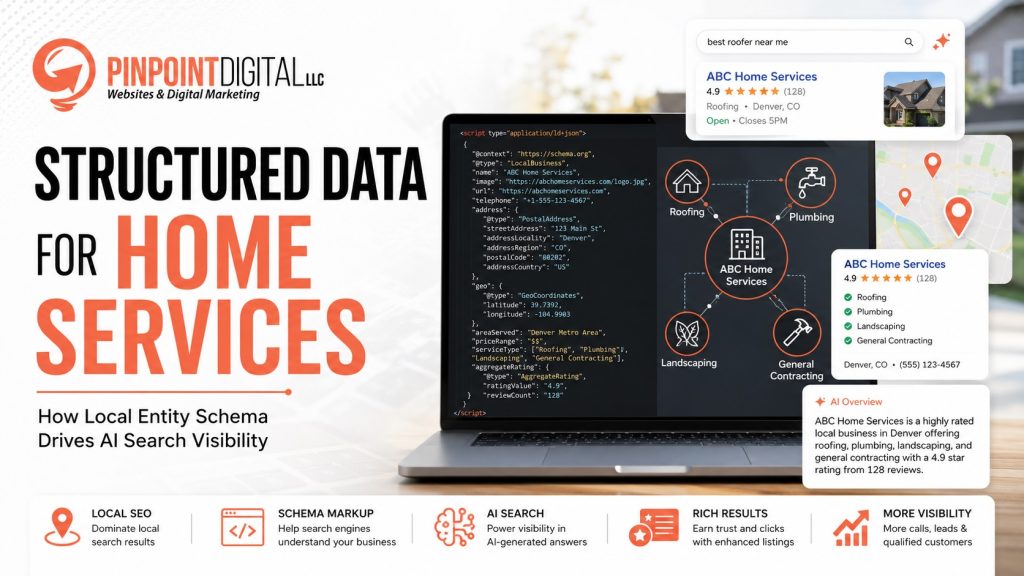
Structured data is code added to a webpage to help search engines understand what the page is about. Google explains that structured data can help its systems understand page content and may also support rich results in search.
For a home service company, structured data can describe:
- Business name
- Service type
- Address
- Phone number
- Website URL
- Service areas
- Reviews
- FAQs
- Blog content
- Team or organization details
- Social profiles
- Specific services
- Local landing pages
A standard service page tells a visitor, “This company offers roof replacement in West Hartford.”
A structured data layer tells search engines, “This entity is a local roofing business, serving this city, offering this service, connected to this website, brand, phone number, address, and content cluster.”
That difference is why schema markup matters for optimizing for AI search.
Why Local Entity Schema Matters for Home Services
Local service businesses compete in crowded markets. A homeowner searching “emergency plumber near me” or “best roofer in CT” may see Google Maps, organic results, ads, AI answers, review snippets, and business profiles before choosing who to call.
Schema helps organize the facts behind the brand.
For home services, local entity schema can connect:
- The business as an Organization or LocalBusiness
- Each service as a Service entity
- Each town page as a Place-based service page
- Each FAQ as a clear answer
- Each blog post as topical authority
- Each review as trust proof when eligible and compliant
- Each address and phone number as local validation
Schema.org defines LocalBusiness as a physical business or branch, and Google recommends using the most specific LocalBusiness subtype when possible.
For contractors, that means the goal is not random code. The goal is clean entity architecture.
Schema Is Not Just for Rich Snippets
Many business owners think schema only exists for rich snippets Google results. Rich snippets are useful, but they are only part of the value.
Google states that structured data can make pages eligible for rich results, but it does not guarantee that rich results will appear. Google also recommends JSON-LD as the preferred structured data format.
That means schema should not be treated like a shortcut. It should be treated as a technical SEO foundation.
At Pinpoint Digital, our approach to advanced technical SEO focuses on helping search engines and AI systems connect the dots across a website. When a home service brand has clear services, clear locations, clear internal links, clear page titles, and matching schema, the site becomes easier to understand.
That clarity can support:
- Better local relevance
- Stronger entity recognition
- Cleaner service-area signals
- Better crawl comprehension
- Rich result eligibility
- More reliable AI search interpretation
- Stronger content relationships
The Problem With Basic Schema Markup Generators
A simple schema markup generator can create code, but code alone does not create strategy.
Most basic generators ask for a business name, phone number, address, and website URL. That can help, but home service SEO needs more detail.
A roofing company, landscaping company, excavation contractor, plumber, or HVAC company may need schema that connects:
- Homepage schema
- LocalBusiness schema
- WebSite schema
- Organization schema
- Service schema
- BlogPosting schema
- FAQPage schema
- BreadcrumbList schema
- Review or AggregateRating markup when compliant
- AreaServed markup
- SameAs social profile links
- Location pages
- Service pages
- Author or publisher data
A generator can output a script. A strategy connects the brand’s entire local footprint.
That is where our Connecticut web design and digital marketing work fits together. A website needs to look professional, convert visitors, load cleanly, rank locally, and speak clearly to search engines.
How Schema Helps AI Search Choose Local Recommendations
AI search systems look for clear, trusted, consistent information. A website with scattered details makes that harder. A site with structured data gives search engines a cleaner source of truth.
For example, a landscaping company may have a homepage, service pages, town pages, project pages, and blog posts. Without entity structure, search engines have to infer how everything relates.
With schema, we can help clarify:
- This company is a local landscaping business.
- These are the services offered.
- These towns are served.
- This page is about commercial lawn mowing.
- This blog supports the service cluster.
- This FAQ answers a local buyer question.
- This phone number, business name, and website belong to the same entity.
That does not force AI systems to choose a business, and no ethical SEO strategy should promise that. But it does make the business easier to validate, understand, and recommend when the content, authority, reviews, and relevance support the search intent.
Local SEO Strategy Starts With Entity Consistency
Schema works best when the entire local presence is consistent.
Before adding code, we review:
- Business name consistency
- Address consistency
- Phone number consistency
- Service area accuracy
- Google Business Profile details
- Website footer details
- Contact page details
- Service page structure
- Blog content clusters
- Internal linking
- Local landing page quality
- Review signals
- Image alt text
- Page speed and crawl health
For service companies, this matters because Google and AI search systems compare information across many signals. A business page that says one thing, a Google Business Profile that says another, and schema that says something else can weaken trust.
That is why schema should match visible page content. Google’s structured data guidelines state that markup should represent the main content of the page and should not mark up hidden or misleading content.
Best Schema Types for Home Service Websites
A strong home service website often benefits from a layered schema setup.
LocalBusiness Schema
This identifies the company as a local business. For a contractor, this can include the business name, phone number, address, URL, service area, opening hours, and sameAs links.
Service Schema
This helps define each major service, such as roof replacement, siding installation, lawn care, excavation, paving, plumbing, or landscape design.
BlogPosting Schema
This supports educational content and helps search engines understand the blog title, author, publisher, publish date, image, topic, and page URL.
FAQPage Schema
This can support question-based content when the questions and answers are visible on the page.
BreadcrumbList Schema
This helps define site hierarchy and page relationships.
Organization Schema
This supports brand-level entity recognition and can connect the website, logo, social profiles, and business identity.
Example: Schema Architecture for a Contractor Website
A contractor website should not rely on one schema block across every page. Each page should have markup that reflects its purpose.
A homepage may include:
- Organization
- LocalBusiness
- WebSite
- SearchAction
- Service overview
- SameAs links
A service page may include:
- Service
- LocalBusiness provider
- FAQPage
- BreadcrumbList
A town page may include:
- Service
- areaServed
- LocalBusiness
- FAQPage
- BreadcrumbList
A blog post may include:
- BlogPosting
- Organization publisher
- Author
- BreadcrumbList
- FAQPage when relevant
This structure gives crawlers a cleaner map of the business.
Why This Matters for Contractors and Landscapers
Pinpoint Digital works with many service-based businesses, including contractors, landscapers, landscape suppliers, nonprofits, and small businesses. Our site includes dedicated pages for contractor marketing, landscaper marketing, small business websites, and landscape supplier marketing.
For these industries, schema can support searches such as:
- Landscaper near me
- Roofing company in CT
- Paving contractor near me
- Mulch delivery near me
- Plumber in Hartford County
- Commercial snow removal CT
- Excavation contractor near me
- Web design for contractors
- Local SEO strategy for trades
The more precise the schema, content, and internal links become, the easier it is for search engines to understand which business should be associated with which service and location.
Structured Data and Internal Linking Work Together
Schema should not replace internal linking. It should reinforce it.
A strong page should connect users to related resources. For example, a blog about local SEO can link to:
- Digital marketing services
- Connecticut web design
- Contractor marketing
- Landscaper marketing
- Small business websites
- Pinpoint Digital blog
Those links help visitors move through the site and help crawlers understand topical relationships.
The code explains the entity. The content proves the expertise. The links connect the full strategy.
How We Validate Schema Before Launch
A schema setup should be tested before publishing. We typically review:
- JSON-LD formatting
- Required and recommended properties
- Duplicate entity conflicts
- Page-to-schema alignment
- Crawlable image URLs
- Valid canonical URLs
- Rich result eligibility
- LocalBusiness accuracy
- FAQ visibility
- Internal link support
- Search Console enhancement reports after launch
Google provides a Rich Results Test for checking which rich results may be generated from structured data on a publicly accessible page.
Validation matters because a small syntax error can break the entire code block.
Building an AI-Ready Local SEO Foundation
AI search visibility starts with clarity.
A home service company should have:
- Clear service pages
- Clear town pages
- Clear proof of work
- Helpful blog content
- Accurate business details
- Strong reviews
- Fast mobile performance
- Clean internal links
- Valid schema markup
- Consistent Google Business Profile data
Structured data is not a magic ranking button. It is a signal layer that helps search systems understand the business faster and with greater confidence.
For Connecticut businesses that want stronger local visibility, better rich result eligibility, and a more AI-ready website, schema architecture should be part of the plan from the start.
At Pinpoint Digital, we build websites and digital marketing systems that connect design, content, SEO, technical structure, and conversion strategy. From contractor marketing to landscaper marketing and full Connecticut web design, our goal is simple: help local businesses become easier to find, easier to trust, and easier to contact.
FAQs
What is structured data for home service businesses?
Structured data is code that helps search engines understand a home service business, including its name, services, service areas, address, phone number, reviews, FAQs, and website content.
Does schema markup improve local SEO?
Schema can support local SEO by helping search engines understand business details and page relationships. It does not guarantee rankings, but it can improve clarity, rich result eligibility, and entity recognition.
What schema should a contractor website use?
A contractor website may use LocalBusiness, Organization, Service, BlogPosting, FAQPage, BreadcrumbList, and WebSite schema depending on the page type.
Can a schema markup generator handle advanced technical SEO?
A schema markup generator can create basic code, but advanced technical SEO requires strategy, page mapping, entity relationships, validation, and consistency across the website.
How does structured data help with AI search?
Structured data helps AI search systems understand business facts, services, locations, and content relationships more clearly. This can support stronger visibility when the website has relevant content, trust signals, and local authority.